Real Estate Opportunity in Africa: Investing Where Population Booms (2025–2050)

OPEN AFRICA INSIGHT NEWSLETTER
Africa is undergoing a demographic transformation. By 2050, the continent will house more than a quarter of the world’s population. For real estate investors, this growth is more than just a statistic—it signals a profound opportunity. Population growth fuels demand for housing, commercial space, infrastructure, and services. Knowing where this growth is concentrated can give early investors an enormous edge.
In this newsletter, we break down projected population growth in Africa’s major regions through 2050 and identify the most promising cities and countries for real estate investment.
Understanding Africa’s Population Explosion
Africa’s total population is expected to double by 2050, reaching over 2.5 billion. This growth is not evenly spread. The regions seeing the largest increases are East and West Africa, driven by high birth rates and improving healthcare.
From the chart below, we see:
- East Africa leads with projected growth from 450 million to 870 million people.
- West Africa closely follows, expanding from 430 million to 770 million.
- Central and Southern Africa have moderate but steady growth.
- North Africa grows at a slower pace, from 260 to 360 million.
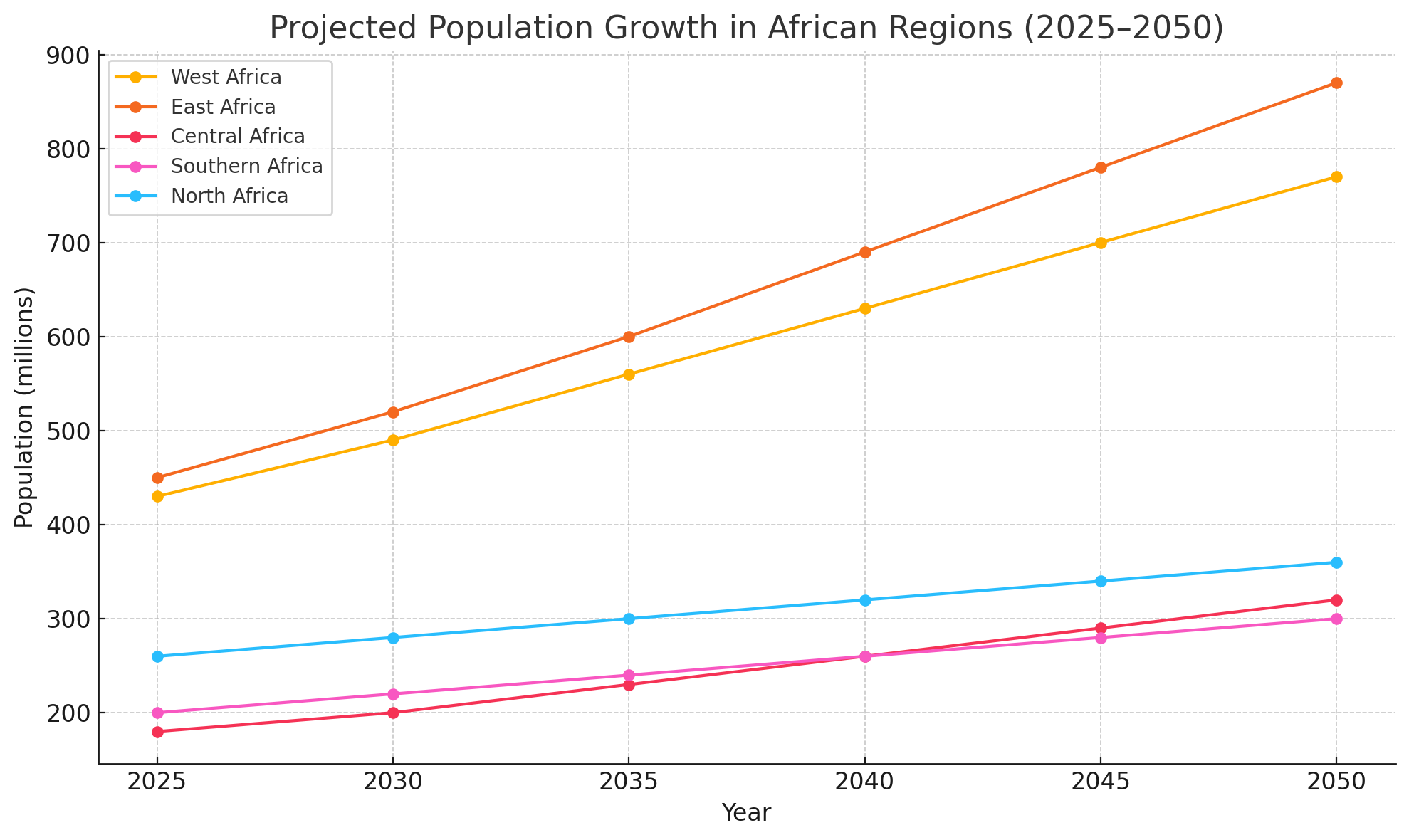
This data suggests a clear investment direction: follow the people.
Where to Invest: Real Estate Implications by Region
East Africa: Nairobi, Addis Ababa, and Kampala
- Why It’s Hot: Massive urban migration, a young workforce, and digital innovation.
- Investment Angle: Mid-income and affordable housing, logistics hubs, and student accommodations.
- Case Study: Nairobi’s satellite towns like Athi River and Kitengela have seen 15–20% annual land appreciation.
West Africa: Lagos, Accra, and Abidjan
- Why It’s Hot: High population density, economic hubs, and cross-border trade potential.
- Investment Angle: High-rise urban housing, gated communities, and smart city developments.
- Data Point: Lagos faces a housing deficit of over 3 million units.
Central Africa: Kinshasa and Yaoundé
- Why It’s Worth Watching: High population growth but slower infrastructure development.
- Investment Angle: Long-term land banking and public-private housing projects.
Southern Africa: Johannesburg, Windhoek, and Lusaka
- Why It’s Stable: Slower growth but more developed legal systems and investor protection.
- Investment Angle: REITs, student housing, and vacation rentals in economic zones.
North Africa: Cairo, Casablanca, and Tunis
- Why It’s Evolving: Mature markets with modernization trends.
- Investment Angle: Commercial and mixed-use developments targeting the rising middle class.
Real Estate Demand Drivers Beyond Demographics
While population growth is the foundation, other trends accelerate real estate demand:
- Digital Penetration: Mobile banking and remote work increase demand for digital infrastructure and co-working spaces.
- Infrastructure Spending: Massive government and foreign-funded transport and energy projects.
- AfCFTA: The African Continental Free Trade Area is turning cities into logistics and trade hubs.
How to Invest Smartly in Growing Regions
Here are a few strategies tailored to Africa’s demographic future:
- Buy-and-Hold in Urban Fringe Zones: Land on the outskirts of capital cities is appreciating fast due to urban sprawl.
- Partner with Local Developers: Reduces regulatory risk and increases on-ground insight.
- Focus on Multi-Family Units: High rental demand from young professionals and students.
- Use REITs: South Africa’s JSE has active REITs. Kenya and Ghana are developing REIT regulations.
The Investor’s Advantage in 2025
Timing is everything. Investing in real estate is not just about buying property—it’s about buying the future. Population data gives us a predictive map of where demand will rise. By entering now, you’re positioning yourself ahead of institutional capital and large-scale developers.
Here’s why it matters:
- Population drives housing
- Housing drives infrastructure
- Infrastructure drives value appreciation
Africa’s growth story is not coming—it’s here. And the smartest investors are those who can see the long-term trajectory before the rest of the market catches up.
Follow the People, Find the Profits
With East and West Africa expected to drive the bulk of population growth, cities like Nairobi, Lagos, Accra, and Addis Ababa present golden opportunities for forward-thinking real estate investors. Combining youth, growth, and policy reform, these regions are poised to become the real estate hotspots of the next quarter-century.
Call to Action
Want early access to exclusive market insights across Africa? Subscribe to our newsletter for data-driven investment intelligence, twice a week!
This newsletter is prepared by OpenAfrica Insights for informational purposes only and does not constitute investment advice.


